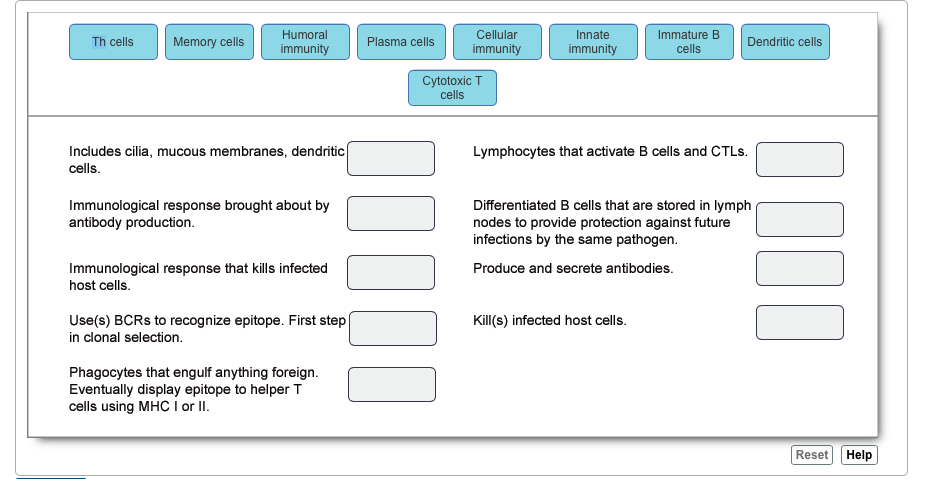
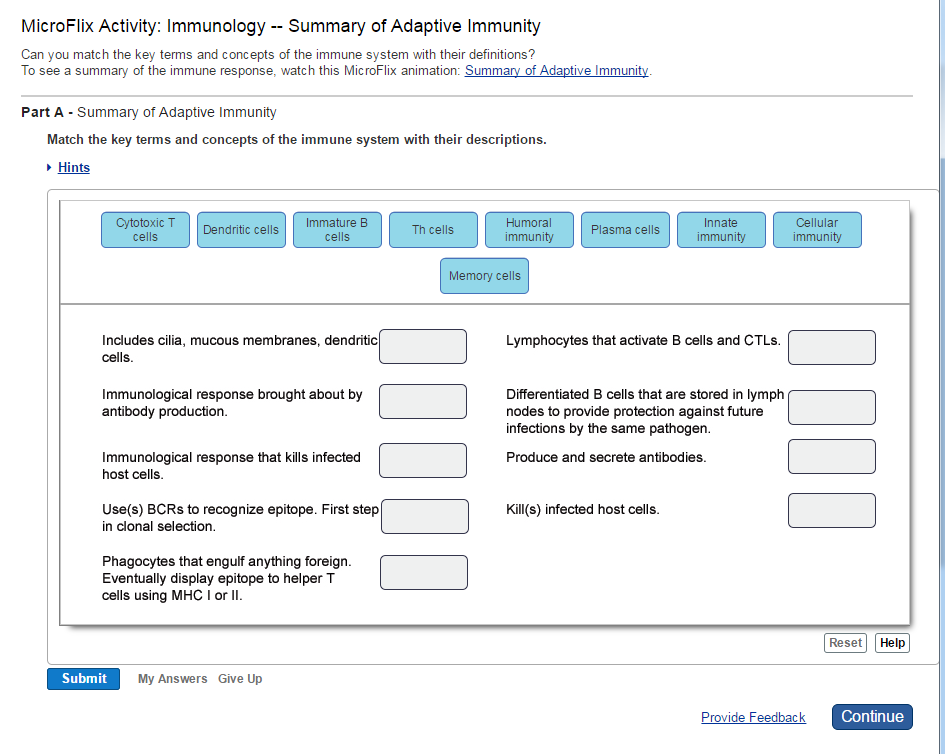
match the key terms and concepts of the immune system with their descriptions.
If you are immune to a disease you can be exposed to it without becoming infected. Up to 24 cash back Antigen-A moulecule that the immune system recognizes either as part of your body or as comming from outside of the body.
 |
| Solved Part A Summary Of Adaptive Immunity Match The Chegg Com |
Lymph nodes are a communication hub where immune cells sample information brought in from the body.
. Vaccines are usually administered through needle injections but some can be administered by mouth or sprayed. The immune system distinguishes self from nonself and eliminates potentially harmful nonself molecules and cells from the body. Immunological response brought about by antibody production c. There are three main groups of phagocytes.
Adaptive immunity occurs later as it relies on the coordination and expansion of specific adaptive immune cells. The lymphatic system is a conduit for travel and communication between tissues and the bloodstream. Summary of Adaptive Immunity. These two systems work closely together and take on different tasks.
Anti-Bodies- A protien produced by a B-Cell of the immune system that destroys pathogens. Because of their location at the. Cell-mediated B lymphocytes B cells Professional antigen presenting cells APC and MHC II complexes. Your immune system is a large network of organs white blood cells proteins antibodies and chemicals.
A preparation that is used to stimulate the bodys immune response against diseases. The antibodies may stick to multiple bacteria causing agglutination. First step in clonal selection e. We will then consider B and T cells.
100 14 ratings 1Includes cilia mucous membranes and dendritic cells - Innate Immunity. The decreased ability of the body to fight infections and other diseases. Types of immune responses. The tonsils are also part of the immune system.
Immune memory follows the adaptive response when mature adaptive cells highly specific to the. An antibody also known as an immunoglobulin Ig is a protein that is produced by plasma cells after stimulation by an antigen. Lymphocytes that can recognize a pathogen years later. These mechanisms include ph.
AIDS- A disease caused by a virus that attacks the immune. The immune system of the human body is made up of entire organs and vessel systems like the lymph vessels as well as individual cells and proteins. Monocytes and macrophages granulocytes and dendritic cells all of which have a slightly different function in the body. Immune cells are carried through the lymphatic system and converge in lymph nodes which are found throughout the body.
B cell activation plasma cell differentiation 7. Cleveland Clinic is a non-profit academic medical center. Innate immunity refers as to nonspecific defense mechanisms which come into play immediately or within hours of an antigens appearance in the body. Part A - Summary of Adaptive Immunity Match the key terms and concepts of the immune system with their descriptions.
Antibodies occur in the blood in gastric and mucus secretions and in breast milk. They are a key component of the innate immune system. Ontogeny of the immune system 3. The immune system fights germs and foreign substances on the skin in the tissues of the body and in bodily fluids such as blood.
Includes cilia mucous membranes dendritic cells b. Proteins that match specific antigens based on shape. A snapshot of the immune system 2. Series of barriers cells and soluble mediators that combine to response to infections of the body with pathogenic organisms.
The innate immune system 4. Innate and adaptive humoral vs. The immune system also has the capacity to recognize and destroy abnormal cells that derive from host tissues. Immunological response that kills infected host cells d.
Protection from an infectious disease. Antibodies are the agents of humoral immunity. Overview of t cell subsets 6. Part A - Summary of Adaptive Immunity Match the key terms and concepts of the immune system with their descriptions.
The modern model of immune function is organized into a three phases immune response based on the timing of their effects. Any molecule capable of being recognized by the immune system is considered an antigen Ag. Match the key terms and concepts of the immune system with their descriptions. Match the key terms and the concepts of the immune system with their descriptions.
Match the following terms to their description. The immune system defends our body against invaders such as viruses bacteria and foreign bodies. Antigen antibodies effector cells memory cells and clonal selection. Innate immunity occurs immediately when circulating innate cells recognize a problem.
Uses BCRs to recognize epitope. Definition of Terms. Nonspecific protective mechanisms repel all microorganisms. An immune response is generally divided into innate and adaptive immunity.
The antibodies may coat the surface of the bacteria opsonization allowing for it to be tagged for phagocytosis. Resistant to the effects of pathogens. The organs of the immune system include skin and mucous membranes and the organs of the lymphatic system too. B-Cells- A lymphocyte that produces protiens that help destroy pathogens.
Immune system the complex group of defense responses found in humans and other advanced vertebrates that helps repel disease-causing organisms pathogens. Here we explain how it works and the cells organs. The immune system is a collection of barriers cells and soluble proteins that interact and communicate with each other in extraordinarily complex ways. Includes cilia mucous membranes dendritic cells.
They require a signal from helper T cells to know that. The innate general immune system and the adaptive specialized immune system. The immune system is made up of two parts. The white blood cells are a key component.
Immature B cells have not yet learned to what they should respond. Types of B cells There are three types of B cells. Antibody structure classes cd nomenclature. This system works together to protect you from foreign invaders bacteria viruses parasites and fungi that cause infection illness and disease.
Immune cells that secrete antibodies or destroy pathogens. Immunological response brought about by antibody production. You did not open hints for this part. Immunity from disease is actually conferred by two cooperative defense systems called nonspecific innate immunity and specific acquired immunity.
Mhc antigen presentation 5. The B lymphocyte B cell is one of the most important cells of the body.
| 1 |
 |
| Solved Match The Key Terms And Concepts Of The Immune System Chegg Com |
| 1 |
| 1 |
| 3 |

Posting Komentar untuk "match the key terms and concepts of the immune system with their descriptions."